






What Does Mercury Represent in Astrology?
Mercury, the messenger of the gods, is one of the most fascinating planets to study in astrology. If you have ever wondered what does Mercury represent in astrology, the answer begins with communication, expression, and the remarkable ability of the mind to take in, sort, and deliver information. As the ruler of both Gemini and Virgo, Mercury governs how we think, speak, and make sense of the world around us. It is not an emotional planet — it is unemotional, sharp, analytical, and deeply curious by nature.What makes Mercury stand out is how it operates at the day-to-day level. In modern life, we often encounter someone’s Mercury before anything else — through a text, an email, or their written words online.
Whether someone is flowery in speech, concise in their language, or strictly business-like in their personal communications, Mercury shapes it all. It coordinates thought processes, filters sensory information from both conscious and unconscious sources, and helps us make sense of what we perceive. At Get Matrix Destiny, understanding Mercury’s placement is often the first lens we use when interpreting a chart, because how someone communicates says everything about how they engage with the world.When Mercury is working through us fully, we are inquisitive, versatile, communicative, and alive with ideas. But when it is under stress, we can become high-strung, nit-picky, indecisive, or overly technical.
Mercury also rules sibling relationships, maps, letters, travel plans, appointments, roadways, vehicles, advertising, publishing, sales, and public relations — its reach is far wider than most people realise. As the fastest-moving Graha after the Moon, Mercury is never more than 28 degrees from the Sun, and it takes roughly one year to complete its journey through the zodiac.
Mercury Planet Symbolism
The planet rules two very different zodiac signs — Gemini and Virgo — and through them, we see two sides of the same Mercury coin. Gemini reflects the quick-thinking, adaptable, and curious face of Mercury, while Virgo highlights detail, analysis, and practical problem-solving. Together, they make Mercury central to everything from casual conversations to precise decision-making. Physically, Mercury governs the nervous system, the hands, the lungs, and the organs of speech — connecting mental agility directly to physical expression.
The planet rules two very different zodiac signs — Gemini and Virgo — and through them, we see two sides of the same Mercury coin. Gemini reflects the quick-thinking, adaptable, and curious face of Mercury, while Virgo highlights detail, analysis, and practical problem-solving. Together, they make Mercury central to everything from casual conversations to precise decision-making. Physically, Mercury governs the nervous system, the hands, the lungs, and the organs of speech — connecting mental agility directly to physical expression.
Hindu Mythology About Planet Mercury
In Hindu mythology, Mercury is known as Budh — a name rooted in the Sanskrit word for intelligence. There is a well-known story of enmity between the Moon and Mercury, though it is one-sided: the Moon holds no grudge, but Budh maintains the conflict. In Vedic Astrology, Mercury is considered the avatar of Vishnu and is worshipped on Wednesday — a day believed to amplify its positive thoughts, remove obstacles, and bring benefits and happiness to the native.
Mercury’s lineage in Jyotiṣa is equally rich. Budha is the son of Chandra (the Moon) and Tārā, wife of Bṛhaspati (Jupiter) — a birth that itself embodies Mercury’s nature: an unexpected connection formed at the crossing of incompatible forces. In Western Astrology, Mercury was once known as Thoth or Hermes, son of Jupiter and Maia, the daughter of Atlas, and friend of Apollo.
He is the inventor of the Lyre and the God of Commerce — a deity that always exhibits duality. In Hindu Scriptures, Mercury represents Kesava, Narayana, and Madhava, embodying Dwaitham — the principle of plurality, standing in contrast to Saturn’s singularity. Mercury also rules Mithuna and Kanya rashi in the Zodiac, staying approximately one month in each rashi, much like the Sun.
Nature / Characteristics of Planet Mercury
Mercury is perhaps the most variable and convertible of all planets — feminine, effeminate, neutral, dualistic, and vacillating in its temperament. It does not act independently; instead, it shapes itself entirely around the rashi, house, and PAC connections it holds. If associated with benefic factors, it becomes favourable and beneficial in your horoscope. If surrounded by malefics through aspects and conjunctions, it turns malefic.Its elemental nature is Vata or Airy, its direction is North, and it reaches exaltation in Virgo at the 15th degree, while it is debilitated in Pisces at the same degree.
A well-placed Mercury in the birth chart blesses the native with good health, wealth, and speech — the ability to handle more than one task at a single point of time.A strong Mercury placed in a favourable or exaltation sign produces someone intelligent, ingenious, and deeply analytical, with strong retentive power and reproductive ability — truly the messenger of the divine. A beneficial Mercury grants a subtle mind, political brain, sharp intellect, the edge of a skilled disputant, and the precision of a logician — someone who learns almost anything without a teacher and holds ambition to know every science.On the other side, an afflicted Mercury
can make a native phrenetic, cunning, mischievous, and prone to being a worst liar or cheater — a gambler of moods who forgets promises.In practical chart reading, we look at whether Mercury’s expression shows up as persuasive and logical problem-solving, or as miscommunication, nervousness, and restlessness. At Get Matrix Destiny, the distinction between a strong and challenged Mercury often explains why some people communicate with effortless clarity while others struggle to be understood, no matter how much they try.
What Does Mercury Signify / Represent in Vedic Astrology?
To truly answer what does Mercury represent in astrology from a Vedic perspective, we must understand its role as the Graha of the discriminating mind — what is called Buddhi. While the Moon governs the receptive, feeling mind (Manas), Mercury governs the analytical, reasoning, and communicating mind. The Moon tells you how you feel; Mercury tells you how you think, process information, and express what you understand. Mercury rules the third house and sixth house in Kaal Purush Kundali, and acts as the significator of the fourth house (happiness) and the tenth house (profession and career).
As the karak planet of the chest, nervous system, skin, nose, navel, gall bladder, lungs, nerves, tongue, arms, face, and hair, Mercury’s body parts coverage is broad. When afflicted by malefics, it can bring problems related to muscles, and the native may suffer from typhoid, madness, seizure, paralysis, ulcers, dizziness, or cholera. Regarding physical appearance, those born under a strong Mercury’s influence tend to be tall, with a well-formed body, long and slender hands, dark hair, expressive eyes, curved eyebrows, and a thin, shrill voice — and much like Martians, they often appear younger than their actual age.
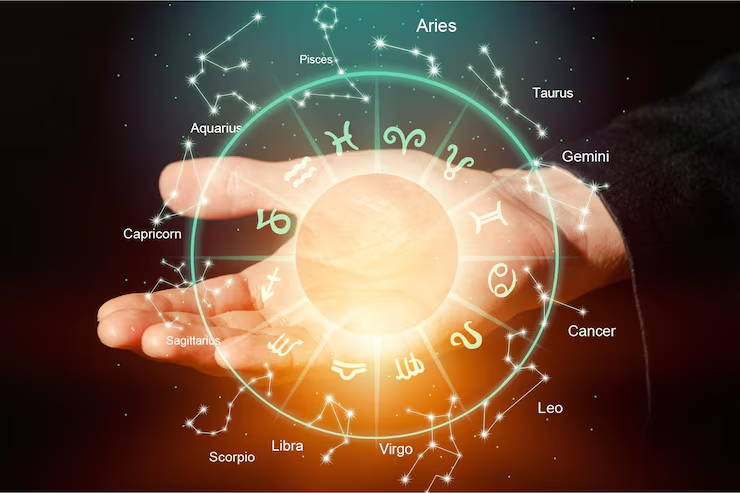
The Spiritual Meaning of Mercury
The spiritual meaning of Mercury is rooted in clarity, awareness, and connection — three qualities that, when combined, become a powerful engine for personal growth. Spiritually, Mercury encourages us to grow through knowledge and self-expression, asking us to develop not just the ability to speak, but equally the discipline to listen, to reflect, and to align our thoughts with our actions. This planet represents the bridge between the inner thoughts we carry privately and the outside world we engage with daily.
Mercury is associated with the everyday but profoundly powerful practices of learning, speaking truth, and exploring ideas. It does not deal in grand cosmic gestures — it works quietly in conversations, in the words we choose, and in the moments when our expression finally matches what we feel inside.
Mercury Retrograde
What does Mercury represent in astrology during retrograde? Mostly, it scrambles what is normally smooth — creating static and confusion felt almost universally. Contracts, major transactions, and decisions are best avoided during these windows. However, there is real value in retrograde too: it is a natural invitation to slow down, do inner reviewing, and reflecting before charging forward. Each retrograde cycle lasts around three weeks, and those who understand its rhythm can navigate it with far more grace than those who do not.
What does Mercury represent in astrology during retrograde? Mostly, it scrambles what is normally smooth — creating static and confusion felt almost universally. Contracts, major transactions, and decisions are best avoided during these windows. However, there is real value in retrograde too: it is a natural invitation to slow down, do inner reviewing, and reflecting before charging forward. Each retrograde cycle lasts around three weeks, and those who understand its rhythm can navigate it with far more grace than those who do not.
What Are the Professions Generally Denoted by Planet Mercury?
Being an airy planet, Mercury is extraordinarily communicative and talkative, which is why its strongest vocational expression tends to be in roles involving language, persuasion, and the movement of information. Natural career fits include salesman, insurance agents, publicity officials, orators, eloquent speakers with ready wit, and those capable of learning many languages. Mercury is the chief governor of education and also the indicator of the uncle in traditional Vedic chart reading.
Professional streams vary significantly based on PAC (Position-Aspect-Conjunction) connections with other influencing planets. When Moon and Mercury connect, you gain fertile imagination, fluent expressions, and success in advertising and conversation. A Mars-Mercury connection brings a healthy, active, and alert mind suited for mechanical engineering, chemistry, medicine, commerce, automobile engineering, and even Navy or Aircrafts roles depending on whether the sign is watery or airy.
A Jupiter-Mercury connection produces prudent and wise individuals suited for journalism, publishing, law, bank, insurance, investment, speculation, literature, accounts, administrative roles, and even Astrologer work. When Venus and Mercury align, the native is cheerful and mirthful, thriving in cinema, drama, travel agencies, designing, layout, shipping, and transport.
Mercury rules over Virgo and Gemini zodiac signs. Its governing day is Wednesday, its precious gemstone is the Emerald, and all green stones fall under its domain — each a reflection of Mercury’s place at the intersection of commerce, Astronomy, and astrology.
Mercury's Planetary Profile in Jyotiṣa (Vedic Astrology)
Mercury — known in Sanskrit as Budha (बुध) — carries a planetary profile that is precise, layered, and practically essential for any serious Jyotiṣa reading. By nature, it is benefic when unafflicted and variable when in malefic association. Its Guṇa is Rājasika — active, stimulating, and outward-directed — and its elemental Tattva is Earth (Pṛthvī). Its Varna is Vaiśya, placing it firmly in the merchant and trader class — a reflection of its deep interest in exchange, commerce, contracts, and the movement of value between parties.
Mercury’s gender is neutral, its direction is North, its governing day is Wednesday (Budhavāra), and its gemstone is the Emerald (Panna). Its associated metal is Bronze or a greenish alloy, and its colour is Green. Its taste (Rasa) is described as mixed and complex — fitting for a planet of such adaptable nature. Mercury’s own signs are Gemini (Mithuna) and Virgo (Kanyā); it reaches exaltation at 15 degrees in Virgo and debilitation at 15 degrees in Pisces (Mīna). Its Mūlatrikoṇa spans Virgo 16 to 20 degrees.
Planetary friendships place Sun and Venus as Mercury’s friends, the Moon as its enemy, and Mars, Jupiter, and Saturn as neutral. Mercury’s body parts rulership covers the nervous system, skin, voice, and intestines, and its Daśā duration in the Vimśottarī system runs for 17 years. Its three Nakṣatras — Āśleṣā, Jyeṣṭhā, and Revatī — each carry a distinct register: Āśleṣā brings penetrating, coiling, deep psychological perception and strategic thinking; Jyeṣṭhā carries seniority, authority through knowledge, and leadership through intelligence; and Revatī carries gentleness, completeness, spiritual depth, and compassionate expression — the final station of the zodiac’s 27 Nakṣatras.
Mercury in the Houses
Understanding what does Mercury represent in astrology through the houses gives us a detailed map of where in life its communicative and analytical energy is most concentrated. In the 1st house, Mercury ties your identity to your words — you come across as quick-thinking, witty, and expressive, making a strong first impression through communication. In the 2nd house, your thoughts orbit finances and values, and you may excel in negotiating or teaching about money. In the 3rd house — its most natural placement — Mercury makes you chatty, curious, and deeply skilled with language, with strong ties to siblings, neighbours, and your local community.
The 4th house places Mercury in the realm of family conversations and home life, with the mind drawn toward roots, ancestry, and personal foundations. In the 5th house, communication becomes creative and expressive — storytelling, writing, artistic performance, and playful, dramatic self-expression come naturally. The 6th house channels Mercury into daily routines, work, and health — producing gifted organisers and people skilled in problem-solving and giving practical advice. The 7th house makes relationships thrive on dialogue and intellectual connection, while the 8th house draws conversations toward transformation, intimacy, and hidden truths.
In the 9th house, Mercury seeks big ideas, philosophy, travel, and the teaching of different cultures and worldviews. The 10th house links career and reputation directly to communication — placing you as a public speaking authority or professional writing voice in your field. The 11th house makes you the organiser of friends, networks, and communities, always full of innovative ideas. And in the 12th house, Mercury turns private and intuitive, sometimes spiritual — its energy flowing inward through imagination, dreams, and hidden realms.
Mercury in Each Sign
Mercury in each zodiac sign shifts the entire flavour of how a person thinks, speaks, and shares information. In Aries, communication is fast, direct, sometimes impatient — thoughts arrive quickly and words are bold and assertive. In Taurus, speech is steady, practical, and grounded — focused on the tangible and the reliable. In Gemini, Mercury is at home: quick-witted, adaptable, curious, with words that flow easily and a natural love of learning and sharing. In Cancer, communication becomes emotional and intuitive — nurturing in tone, laced with empathy and sensitivity.
In Leo, Mercury expresses with confidence, drama, and creativity — speech has flair and a natural ability to command attention. In Virgo, thoughts are precise and analytical, information processed logically and carefully. In Libra, words are diplomatic, balanced, and cooperative, always seeking harmony and fairness in relationships. In Scorpio, conversations are intense and insightful, constantly probing hidden truths and deeper meaning.
In Sagittarius, expression turns optimistic and philosophical — stretching toward big concepts and far-reaching visions. In Capricorn, thought is disciplined and strategic, communication anchored in practical and long-term goals. In Aquarius, words and ideas are innovative and future-focused — sometimes unconventional and ahead of the times. And in Pisces, communication is imaginative, empathetic, and intuitive — poetic, dreamy, and deeply driven by emotion.
Mercury and Other Planetary Connections
Mercury’s expression is never isolated — it shifts and deepens based on every planetary connection it forms through aspects in the chart. Sun and Mercury together align identity with communication, creating a powerful link between self-expression and personal purpose. Moon and Mercury weave emotions into thought, shaping how feelings are communicated and met with empathy and understanding. Venus and Mercury blend charm and beauty into words — supporting artistic expression and harmonious dialogue in every exchange.
Mars and Mercury inject drive, passion, and raw energy into speech, though this can tip into impulsiveness or arguments under tension. Jupiter and Mercury expand the mind generously — encouraging philosophical, big-picture thinking and natural optimism in communication. Saturn and Mercury impose discipline, seriousness, and structure on thought, sometimes producing cautious or reserved speech but always with precision. Uranus and Mercury spark originality and sudden insights — producing inventive and unconventional ideas that break existing patterns. Neptune and Mercury fuse imagination with thought — beautiful for creativity, but prone to blurring clarity and boundaries. Pluto and Mercury add depth, intensity, and transformative power to communication — the hallmark of probing and investigative thinking.
The Importance of Mercury in Astrology
Mercury is one of the most significant planets in astrology because it operates as the vital link between thought and action — the engine that turns inner ideas into words and practical communication. Without Mercury’s influence, thoughts might remain unspoken and connections incomplete, leaving real gaps in how people interact with the world. What does Mercury represent in astrology at its deepest level? It represents the irreplaceable act of exchange — the passing of information, value, and understanding from one person to another.
Mercury’s Varna as Vaiśya — the merchant and trader class — captures this truth perfectly. Whether it is the trade of goods, the exchange of ideas in conversation, or the careful negotiation of agreements, Mercury governs all movement of value between parties. A strong Mercury in the chart consistently appears in the profiles of those who make their living through the movement and exchange of both information and value.
Remedies for Mercury
For those working to strengthen Budha in their chart, the most effective remedies combine ritual and lifestyle. Reciting the Budha Mantra and performing Budha Puja — especially on Wednesday — is a traditional starting point. Wearing an Emerald (Panna) gemstone, set in the correct metal, is the classical recommendation for those seeking Mercury’s positive expression in daily life.
Beyond formal remedies, Mercury’s energy thrives when the mind is kept active, curious, and engaged. Daily habits such as reading, writing, journaling, and learning new languages sharpen communication skills in ways that Mercury deeply resonates with. Keeping up stimulating conversations, staying curious about the world, and practising mindfulness all support Mercury’s influence organically. Even the act of wearing green or incorporating it into your surroundings — through decor, clothing, or rituals and meditations — is said to symbolically strengthen Mercury’s energy and invite its most positive expression.
FAQs ( Frequently Asked Questions )
What does Mercury represent in astrology?
Mercury represents communication, intellect, and the analytical mind in astrology. It governs how you think, speak, write, and process information. As the ruler of Gemini and Virgo, it influences everything from daily conversations to major decision-making, making it one of the most practically significant planets in any birth chart.
What does Mercury represent in astrology for Vedic traditions?
In Vedic astrology, Mercury is known as Budha — the Graha of intellect, speech, and commerce. It governs the analytical mind (Buddhi), rules the third and sixth houses in Kaal Purush Kundali, and its Mahādaśā runs for 17 years in the Vimśottarī system. It is considered the avatar of Vishnu and is worshipped on Wednesdays.
What body parts does Mercury rule in astrology?
Mercury governs the nervous system, skin, lungs, tongue, arms, hands, face, hair, navel, and gall bladder. When Mercury is afflicted in a birth chart, it can cause issues related to the nervous system, skin disorders, respiratory problems, and in severe cases, conditions like paralysis or seizures.
What happens when Mercury is strong in a birth chart?
A strong Mercury produces individuals who communicate clearly, think quickly, and excel in writing, teaching, and logical problem-solving. They tend to be sharp, witty, multilingual, and highly analytical. Professionally, strong Mercury natives thrive in fields like journalism, law, commerce, advertising, and education.
What does Mercury retrograde represent in astrology?
Mercury retrograde occurs three to four times a year when Mercury appears to move backwards in the sky. It represents a period of disrupted communication, technology issues, travel delays, and misunderstandings. Astrologers advise against signing contracts or making major decisions during this time and instead recommend slowing down, reviewing, and reflecting.
Which zodiac signs are ruled by Mercury in astrology?
Mercury rules two zodiac signs — Gemini and Virgo. Gemini reflects Mercury’s quick-thinking, curious, and adaptable nature, while Virgo expresses its detail-oriented, analytical, and practical side. Mercury is exalted in Virgo at 15 degrees and debilitated in Pisces at 15 degrees.
What professions does Mercury represent in astrology?
Mercury represents professions related to communication, trade, and intellect. These include writers, journalists, teachers, lawyers, accountants, salespeople, advertising professionals, traders, astrologers, and public speakers. The specific career path is further shaped by Mercury’s conjunctions and aspects with other planets in the birth chart.
What is the lucky gemstone and colour for Mercury in astrology?
The lucky gemstone for Mercury is the Emerald (Panna), traditionally worn to strengthen Mercury’s positive influence in the birth chart. Green is Mercury’s lucky colour, symbolising growth, balance, renewal, and harmony — all qualities that reflect Mercury’s role as the planet of learning, communication, and adaptability.